Tag: trans people

  • Trans athletes have no advantage over women

    The researchers argued that there was no evidence “to justify blanket bans” on trans women taking part in women’s sport.

    The team looked at the strength, fitness and body composition of transgender people taking cross-sex hormones compared with women and men not taking drugs.

    Trans bans are just attempts to distract you from right-wing failures.

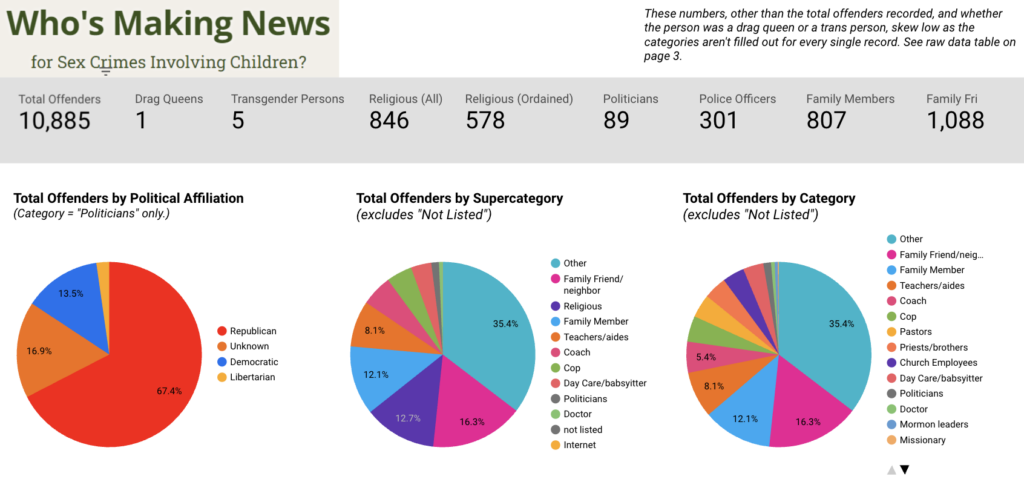
  • Who are the real predators?

    It’s not trans people. It’s authority figures, including clergy, police officers, and Republican politicians.

    who is making news for sex crimes involving children? Clergy, republican politicians, police officers, family members.
  • Debunking trans myths

    Science debunks the 3 biggest myths surrounding trans people.

    1. Being trans is a social phenomenon sweeping through younger generations

      …a study published in the journal Pediatrics in 2022 found that the “social contagion” isn’t supported by real-world data.

      By analysing data from two CDC surveys conducted in 2017 and 2019, it found a small drop in the number of young people identifying as trans. It also found that the proportion of young people assigned female at birth who have come out as trans fell slightly.

      2. Trans people regret transitioning

      Separately, a 2019 survey of 3,398 attendees of a gender-identity clinic in the UK found that just 16 – about 0.47 per cent – experienced transition-related regret. Of these, even fewer went on to detransition. 

      Additionally, a North American study found that 94 per cent of children who came out as trans continue to identify as trans five years later. Approximately 1.3 per cent of young people transitioned to another identity before returning to their trans identity while 2.5 per cent later identified as cisgender and 3.5 per cent as non-binary.

      3. Trans women participating in sports hurts cis women

      A recent report found trans women don’t have any advantages over their cis peers when participating in elite sport. 

      Commissioned by the Canadian Centre for Ethics in Sport, the report is an in-depth review of all scientific literature published between 2011 and 2021 in English regarding trans women and their participation in elite-level sports.
    1. No, trans folks aren’t doing the mass shootings

      According to the Gun Violence Archive (GVA)(opens in a new tab), there were 5,748 mass shootings between Jan 1, 2013 and September 15, 2025 in the U.S. Of that number, there have been five confirmed transgender shooters, GVA told FactCheck.org(opens in a new tab). That means that transgender individuals were responsible for less than 0.1% of incidents over that time period.

      From GLAAD

    2. Detransition is rare

      The 19th reports:

      The Williams Institute at the UCLA School of Law estimates that there are 2.1 million transgender adults in the United States — or about 0.8 percent of the country’s population — and a total of 724,000 trans youth. It is harder to calculate the number of detransitioners, and estimates vary widely, but experts agree the percentage is low. The World Professional Association for Transgender Health (WPATH) describes detransition as “proportionally rare” and notes that as more adults identify as trans, it’s expected that more people will also look to halt or reverse their transition. 

      New Canadian study shows that overwhelming majority of trans youth who access gender-affirming care continue on it:

      The actual subject of detransitioning is complex.

      Detransition refers to the process of stopping, reversing, or pausing aspects of a gender transition. This might involve halting hormone therapy (like testosterone or estrogen), reverting to a birth-assigned name or gender marker, or undoing certain surgical changes. For others, it may simply mean adjusting their social presentation.

      Importantly, detransition is not the same as regret. People detransition for a wide range of reasons, and many eventually retransition, resuming gender-affirming care when their environment or circumstances become more supportive.